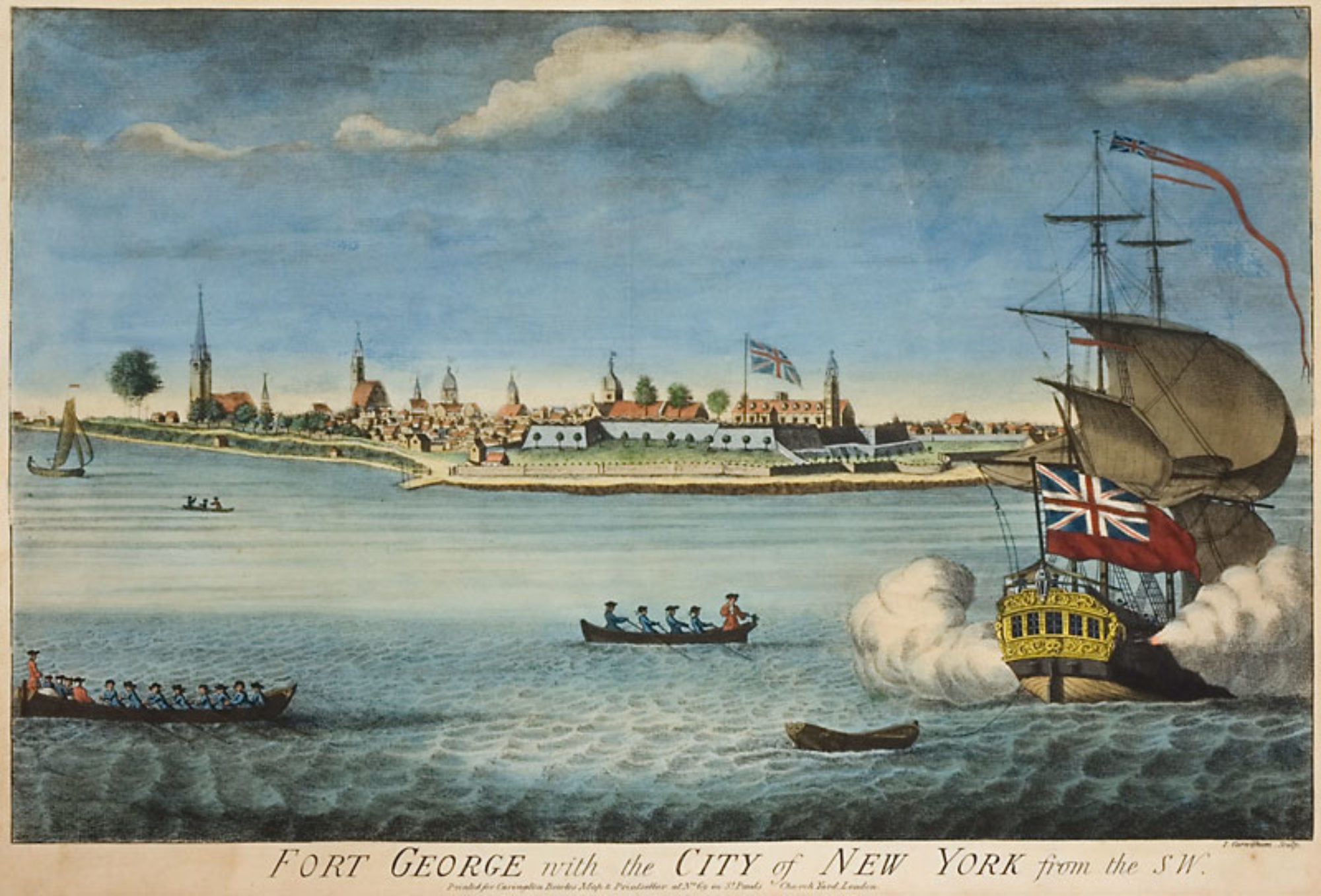


With the Halifax fleet collected at Sandy Hook, General Howe decided to begin his initial operations. The first object was to obtain a foothold on Staten Island. That place was large enough for the British Army to secure itself, was mostly rural, and the population was very conservative and pro-British. It was largely undefended. There were four companies of militia, but again, these were mostly Tory, and could be expected not to fight.
|
ROYAL NAVY SHIPS IN THE STATEN ISLAND OPERATIONS, 1-4 JULY 1776 Vice Admiral of the Blue Molyneaux Shuldham, Chatham |
||||||
|
Name |
Rate |
Class |
Guns |
Men |
Tons |
Commander |
|
Asia |
3rd |
Ship of the line |
64 |
500 |
1364 |
Captain George Vandeput |
|
Chatham |
4th |
50 gun ship |
50 |
370 |
1067 |
Captain John Raynor Vadm Molyneux Shuldham |
|
Centurion |
4th |
50 gun ship |
50 |
350 |
1044 |
Captain Richard Brathwaite |
|
Phoenix |
5th |
Frigate |
44 |
280 |
842 |
Captain Hyde Parker, Jr. |
|
Greyhound |
6th |
Frigate |
28 |
200 |
617 |
Captain Archibald Dickson |
|
Rose |
6th |
Frigate |
20 |
160 |
449 |
Captain James Wallace |
|
Swan |
Sloop |
14 |
125 |
300 |
Commander James Ayscough |
|
|
Senegal |
Sloop |
14 |
125 |
292 |
Commander Roger Curtis |
|
|
Tryal |
Schooner |
Lieutenant John Brown |
||||
The morning of 1 July dawned foggy, with the wind at the southeast, and was warm, with the air temperature at 78° at noon.[1] HM Sloop Swan, at Sandy Hook, reported the day as being foggy with light winds. At 1600 Vice Admiral Shuldham made the signal to sail and the fleet got underway.[2] The fleet got underway with a thunder storm and hard rain playing upon the decks. At 1900 the fleet anchored in Gravesend Bay.[3] Left behind at Sandy Hook were Swan, the Mercury packet and four transports.[4]
 The Americans, seeing the British move and knowing that a landing was imminent, invented a charming story of a landing on Long Island. According to the New-York Journal, 1000 of the British troops landed on Long Island on the west side, but were confronted by 1000 rifle-men. After a time the British retreated, gave the riflemen three huzzas, which was returned by the Americans with the Indian war whoop.[5] There was however, no landing on 1 July.
There was an American detachment on Staten Island under Captain Ephraim Manning. Manning’s job was to assist in collecting the stock on the island and evacuate the cattle, pigs and sheep and goats to New Jersey.[6]
The next day was much like the one before: warm[7] with light breezes in the morning, followed by a windy afternoon with rain squalls and lightening.[8] Between 0400[9] and 0700 the fleet got underway with a division of transports.[10] The British soon ran into difficulties. The Senegal got through The Narrows but the wind tapered off and the ebb tide came on. She drifted to the northwest. At 1200 Senegal bore down to the fleet with the division of transports.[11] According to Greyhound, at 1000 the fleet began to pass through The Narrows. The city of New York was visible in the distance through intermittent rain. About 1300 the ebb tide “made out strong against us.” Greyhound anchored near Staten Island. Part of the fleet was now south of The Narrows and part north of that passage.[12] Rose reported that she passed The Narrows at 1130 and anchored off the northern point of Staten Island, along with the Phoenix and Greyhound. Rose’s log states that “the Tide of Ebb making strong the Fleet could not get through the Narrows.”[13] Phoenix anchored in The Narrows about 1200, with no further comment.[14]

In the afternoon HM Frigate Phoenix made the signal for the fleet to get underway. Phoenix, HM Frigates Rose and Greyhound, HM Sloop Senegal, three armed vessels and a division of transports got under way, to pass through The Narrows between Staten Island and Long Island.[15] A witness aboard the Chatham reported that “the signal was made for the whole fleet to weigh, when the Chatham, passing through the centre, was cheered by every ship. I do not remember seeing a more pleasing sight, which the fineness of the day greatly contributed to, more particularly as we expected we were immediately going to the attack of New York . . .”[16]
With the fleet coming up to The Narrows the flood tide came to. The Centurion manned and armed her flatboats and sent them off to the various transports to land the troops. The boats returned at 2230.[17] Senegal reported that the transports got under way at 1700. At 2000 she anchored off the northeast point of Staten Island and began to land the troops aboard, a task that was completed at 2200. The transports had still not passed The Narrows.[18] Greyhound sailed at 1630, moving closer into the shore. At 1900 she began landing the troops aboard.[19] Rose sailed at 1600 and ran in close to the watering place. At 2100 she made out the Admiral’s signal to land the Grenadiers and Light Infantry. This was done by 2200 and Rose moved further out away from the shore.[20]
 Captain Manning’s small party was aware of this activity. Manning consulted his officers and they unanimously agreed it was time to depart Staten Island, because “the Inhabitants being unfriendly & the Enemy so near & my Party so small.” By 1500 the American troops had left Staten Island. Manning reported to Washington that “they were surrounding the Island with their Shipping, & not long after we crossd the Ferry there came up two Armd Vessels, which I did (with the Assistance of an Officer of the Train & one three Pounder) my Endeavour to drive back & in some measure Effected.”[21]
The following is a letter from Captain Manning to Gen. George Washington apprising him of the situation:
From Captain Ephraim Manning
Wednesday 8 oClock A.M.
[3 July 1776]
May it please your Excellency
Last Night about 12 oClock I recd your Excellencies Orders to give my Assistance in taking the Stock of[f] Staten Island—beg leave to inform your Ex[c]ellency, that by the Advice of all my Officers, I left the Island Yesterday about 3 oClock P.M. the Inhabitants being unfreindly & amp; the Enemy so near & my Party so small, had I staid any longer we must have fallen into their Hands, as they were surrounding the Island with their Shipping, & not long after we crossd the Ferry there came up two Armd Vessels, which I did (with the Assistance of an Officer of the Train & one three Pounder) my Endeavour to drive back & in some masure Effected.
I am now About 5 Mile up in the Jersey side, (my Men being very much fatigued) where I wait your Excellency’s Commands. As their is a large Number landed & continually landing, beg leave to hint to your Excellency, whither a larger Party then I have at present under my Command, will not be necessary. I am with the greatest Respect your Excellencies Most Obedt hume Servt
Ephraim Man[ning]
The American reaction to the events of 2 July was muted. The New York papers reported that some of the British fleet seemed to be coming up in the morning and. By night, some forty-five sail were above The Narrows, all anchored near or nearby the Watering Place on Staten Island. The British fired about fifty shots, perhaps to cover the landings, although no British ships report firing. The Americans could “plainly” see the British troops ashore.22 Another observer simply noted “The Evening before last, & last Evening, they came up thro’ the narrow the greatest part of the Fleet, near 100 sail – & came to under Staten Island.[23]
The morning of 3 July brought much better weather, although cooler. Dr. Moffat, aboard the Swan noted the temperature as 68°.[24] The day was windy but clear.[25] At 0830 the fleet got under way and passed through The Narrows. In the afternoon Centurion manned her boats and began landing the troops from the transports.[26] An observer on the Chatham reported that “the Phoenix, Rose and Senegal . . . [led] the fleet through the Narrows, but the wind dying away obliged us again to anchor. At four o’clock the signal was once more made to weigh, and the fleet boats manned; at six we passed the Narrows amidst a very unsuccessful fire from the rebels, having killed but very few; at seven we landed the army or Staten Island without opposition, when two or three hundred men of the enemy surrendered themselves prisoners of war to the first division of grenadiers.[27] According to the Chatham’s log “the rebels kept a Constant firing of Small Arms from Long Island at the Shipping as they passed by . . .”[28]

The landing operation went on all day.[29] The Americans kept up the small arms fire as the British fleet passed through The Narrows. By afternoon the Americans had gotten a 12-pound gun emplaced on Long Island and began a steady fire on the shipping coming through The Narrows.[30] To cover the landing of the troops the Phoenix moved closer to shore and fired “Several shott at a party of Rebels onshore,”[31]
The British threw out small armed vessels, tenders and such, into the narrow waterways around the island, both to cut off the retreat of any American troops, and to prevent interference with the landings by American reinforcements. Joseph Trumbull noted that they “have sent their Tenders, to lye all around the Island, to cover them, & seem to be preparing to form an Encampment there . . .” He further noted that “Staten Island are mostly Tory’s- they were ordered to send off their stock, but they found means to delay & delay, so that, we had but Just got off the fat Cattle, when the Enemy, as they wished, came on, & prevented our taking off the Lean.”[32] Commenting on this Ensign Caleb Clap stated that “after the Ships hove in sight, our People on Stratton Island drove of about 400 Head of Cattle; soon after that the enemy Landed, and is Reported that took about 30 of our Men.”[33]
The British did not occupy the whole island, merely securing the strong points. The New York Journal reported “It was apprehended they intended to penetrate into the interior parts of the island, or to some of the neighbouring towns, but it does not appear they they have yet attempted it, or done any thing on shore, except taking up a little bridge on the causeway between the Landing and the Highlands, at the Ferry.”[34] Joseph Trumbull reported that the enemy “seem to be preparing to form an Encampment there -I expect they will encamp & secure themselves there, & wait the Arrival, of the Hessians Cossacks Tartars, & & & then Attack us – possibly they will attack us sooner, we should wish it.”[35]
The advance of the British led to a panic of sorts in New York City. Observer Joseph Trumbull reported that “the day before yesterday we expected an imediate attack, & prepared for it, but were disappointed; it has almost Cleared the City of the Women and Children – many have all along tho’t here, that they would not come here, but now they scamper off, very fast.”[36]
The day’s action was not over after nightfall. Eight British boats attempted to land on Long Island during the night. Joseph Trumbull reports the result: “8 of their Boats endeavoured to Land some men last Night, on Long Island, below the Narrows, but our People Ambushed them, killed some of their men took 4 prisoners & drove them back. We have now a Battery at the highland, of the Narrows on Long Island Side & several Guns playing on the Ships & transports passing several transports have turned back below again – these things Enspirit our People the Militia Especially – a finer Set of Men & better Armed I never saw, than the Militia of N Jersey. . .”[37]

The Americans prepared for action on 4 July. The entire army turned out before dawn and manned their lines.[38] Asia, stationed near The Narrows, took parts of Long Island under fire in the afternoon, firing on the newly established battery.[39] The local newspaper published an account of this action: “The Asia brought up the Rear of the Fleet, and in the Narrows was fired at from a small Battery on Long-Island, Which complement was returned by about 40 Twentyfour Pounders, one of which lodged in the Wall of the House of Mr. Bennet, but did no Hurt to the Family; and three Shot had near done much Mischief to the House and Family of Mr. Dennise Dennise, one of them narrowly missing the Kitchen, wherein was a Number of the Family; a Second struck the Barn, and the Third destroyed much of the Fence of the Garden opposite the Front Door of the Mansion House.” Aside from wrecking houses and garden fences Asia did no damage.[40]
British shipping continued to pass up The Narrows, to bring up more transports to complete the occupation of Staten Island. A group of twenty went up at 1000 including the Chatham, and another group at 1900.[41]
The chain of small craft that the British had placed around the island proved vulnerable. On the early morning of 4 July an armed sloop of fourteen guns was off Elizabethtown, New Jersey.42 This was the schooner George. With other schooners she was patrolling the area known as The Sound.[43] She was taken under fire by two 12-pounder guns placed on the shore and “a great Number of her men killed by grape shot, & bored thro & thro – & finally Set on fire, She is yet on fire & the flames & smoke in sight she is totally destroyed -A House full of their Officers, has likewise been shot thro’ -& they driven over the Kills for shelter.”[44] Another observer says “we attack’d a sloop of the enemies mounting eight Carriage Guns – She lay up a small river, which divides Staten Island from the main call’d the Kills. We placed two 9 pounders on Bergen Point – and soon forced the crew to quit her – by the shrieks, some of them must have been kill’d or wounded – the sloop quite disabled.”[45] A third report states that “A Sloop of 12 Six Pounders, belonging to the Fleet from Halifax, laying in the Kills, near Mr. Decker’s Ferry, was almost torn to Pieces last Wednesday Morning, by a Party . . . from the opposite shore, with two 18 Pounders. The crew soon abandoned the Sloop, and we suppose she is rendered entirely unfit for any further Service.”[46] George was not destroyed however, but did have one man killed, her captain,[47] and four wounded.[48] Another report indicates one man was killed and eight or nine wounded.[49] She was hauled in to the dock,[50] Later in the day ten cannon were sent to Elizabethtown “in order to prevent their Landing and Pilleging that Town.”[51]
_____________________________________________________________
1 NDAR, “Diary of Dr. Thomas Moffat,” V, 921-923
2 NDAR, “Journal of H,M. Sloop Swan, Captain James Ayscough,” V, 921; “Journal of H.M.S. Asia, Captain George Vandeput,” V, 920-921; “Journal of H.M.S. Rose, Captain James Wallace,” V, 895-896
3NDAR, “Journal of H.M.S. Rose, Captain James Wallace,” V, 895-896
4 NDAR, “Journal of H,M. Sloop Swan, Captain James Ayscough,” V, 921
5 NDAR, “New-York Journal, Thursday, July 4, 1776,” V, 918-919
6 NDAR, “Captain Ephraim Manning to George Washington,” 5:894-895
7 NDAR, “Diary of Dr. Thomas Moffat,” V, 921-923
8 NDAR, “Journal of H.M.S. Asia, Captain George Vandeput,” V, 920-921; “Journal of H.M.S. Centurion, Captain Richard Brathwaite,” V, 920
9 NDAR, “Journal of H.M. Sloop Senegal, Captain Roger Curtis,” V, 896-897
10NDAR, “Journal of H.M.S. Greyhound, Captain Archibald Dickson,” V, 896
11 NDAR, “Journal of H.M. Sloop Senegal, Captain Roger Curtis,” V, 896-897
12NDAR, “Journal of H.M.S. Greyhound, Captain Archibald Dickson,” V, 896
13NDAR, “Journal of H.M.S. Rose, Captain James Wallace,” V, 895-896
14NDAR, “Journal of H.M.S. Phoenix, Captain Hyde Parker, Jr.,” V, 895
15NDAR, “Journal of H.M.S. Centurion, Captain Richard Brathwaite,” V, 920
16 NDAR, “Journal of Bartholomew James,” V, 919-920
17NDAR, “Journal of H.M.S. Centurion, Captain Richard Brathwaite,” V, 920
18 NDAR, “Journal of H.M. Sloop Senegal, Captain Roger Curtis,” V, 896-897
19 NDAR, “Journal of H.M.S. Greyhound, Captain Archibald Dickson,” V, 896
20 NDAR, “Journal of H.M.S. Rose, Captain James Wallace,” V, 895-896
21 NDAR, “Captain Ephraim Manning to George Washington,” 5:894-895
22 NDAR, “New-York Journal, Thursday, July 4, 1776,” V, 918-919
23 NDAR,”Joseph Trumbull to Jeremiah Wadsworth,” V, 917-918
24NDAR, “Diary of Dr. Thomas Moffat,” V, 921-922
25 NDAR, “Journal of H.M. Sloop Swan, Captain James Ayscough,” V, 921
26NDAR, “Journal of H.M.S. Centurion, Captain Richard Brathwaite,” V, 920
27NDAR, “Journal of Bartholomew James,” V, 919-920
28 NDAR, “Journal of H.M.S. Chatham, Captain John Raynor,” V, 897
29 NDAR, “Journal of H.M. Sloop Senegal, Captain Roger Curtis,” V, 896-897; “Journal of H.M.S. Greyhound, Captain Archibald Dickson,” V, 896; “Journal of H.M.S. Phoenix, Captain Hyde Parker, Jr.,” V, 895
30 NDAR, “Journal of H.M.S. Chatham, Captain John Raynor,” V, 897
31 NDAR, “Journal of H.M.S. Phoenix, Captain Hyde Parker, Jr.,” V, 895
32 NDAR, “Joseph Trumbull to Jeremiah Wadsworth,” V, 917-918
33 NDAR, “Diary of Ensign Caleb Clap,” 5:894
34NDAR, “New-York Journal, Thursday, July 4, 1776,” V, 018-919
35 NDAR, “Joseph Trumbull to Jeremiah Wadsworth,” V, 917-918
36 NDAR, “Joseph Trumbull to Jeremiah Wadsworth,” V, 917-918
37 NDAR, “Joseph Trumbull to Jeremiah Wadsworth,” V, 917-918
38 NDAR, “Diary of Ensign Caleb Clap,” V, 917
39 NDAR, “Journal of H.M.S. Asia, Captain Geoirge Vandeput,” V, 920-921
40 NDAR, “New-York Gazette, Monday, July 8, 1776,” V, 973-974
41 NDAR, “Diary of Ensign Caleb Clap,” V, 917
42 NDAR, “Joseph Trumbull to Jeremiah Wadsworth,” V, 917-918
43 NDAR, “Journal of Lieutenant Colonel Stephen Kemble,” V, 937
44 NDAR, “Joseph Trumbull to Jeremiah Wadsworth,” V, 917-918
45 NDAR, “Journal of Lieutenant Colonel Samuel Blancley Webb,” V, 917
46NDAR, “New-York Gazette, Monday, July 8, 1776,” V, 973-974
47 NDAR, “The Examination of James MacFarlan a soldier belonging to the 55th Regiment, Colo. Medie-,” V, 936-937; “Journal of Lieutenant Colonel Stephen Kemble,” V, 937
48 NDAR, “Journal of Lieutenant Colonel Stephen Kemble,” V, 937
49 NDAR, “Examination of Ebenezer Colefox, Sailor, deserter from the Enemy’s Fleet,” V, 974-975
50 NDAR, “Journal of Lieutenant Colonel Stephen Kemble,” V, 937
51 NDAR, “Diary of Ensign Caleb Clap,” V, 917
________________________________________________
Chronology taken from website American War Of Independence At Sea
Discover more from The Revolutionary War on Staten Island
Subscribe to get the latest posts sent to your email.